The aftermarket performance industry transforms everyday vehicles into personalized machines that match your driving ambitions. From subtle enhancements that sharpen throttle response to complete overhauls that double your horsepower, the aftermarket world offers solutions for every goal and budget.
This guide walks you through performance components, from understanding quality parts to choosing upgrades that deliver results. The difference between a successful build and an expensive mistake comes down to knowledge and smart component selection.
What are aftermarket parts?
Aftermarket parts are replacement components manufactured by companies other than the original vehicle manufacturer. These parts include everything from brake pads to body panels, produced by independent manufacturers like Bosch, Monroe, or Dorman. Aftermarket parts offer alternatives to OEM components at various price points and quality levels, ranging from budget replacements to performance upgrades that exceed original specifications.
The aftermarket industry emerged from racing communities who demanded more than manufacturers offered. Companies like Brembo, Bilstein, and Garrett develop technologies that often find their way into future OEM applications.
Performance aftermarket parts differ from standard replacements through intent and engineering. A performance brake pad uses advanced compounds providing better heat resistance and reduced fade. These parts are purposefully better for specific applications.
The beauty lies in choice. Where manufacturers offer one solution for average drivers, aftermarket companies provide options tailored to specific needs. Track day warrior? There's a brake compound for that. This specialization lets you build a vehicle matching your exact requirements.
Overwhelmed by choices? Download MotorMia to get tailored recommendations for parts based on your goals and needs, backed by real installation data from thousands of builds.
Why performance components matter for car enthusiasts
Performance components transform the driver-machine relationship. Stock vehicles prioritize broad appeal and cost targets, leaving performance potential untapped. Aftermarket parts unlock that potential, turning competent vehicles into exceptional ones.
Manufacturers tune engines balancing power against warranty concerns and emissions standards. That conservative approach leaves significant gains available.
A simple ECU tune can unleash 20-30% more power from turbocharged engines. Add supporting modifications, and gains multiply.
Performance encompasses more than speed though. Upgraded suspension transforms vehicle response, inspiring confidence through corners, better brakes maintain consistent performance during hard use.
The enthusiast community drives innovation beyond manufacturer capabilities. Aftermarket companies focus on enthusiasts who demand excellence, bringing to the market specialized solutions that deliver what performance-minded drivers actually want.
Types of aftermarket performance parts
Aftermarket performance parts include engine upgrades, exhaust systems, suspension kits, brake enhancements, intake systems, forced induction, ECU tuning, cooling components, drivetrain modifications, and performance wheels and tires.
These parts improve power, handling, braking, and reliability, with gains ranging from 5–15 horsepower to doubling output in turbo builds.
Let’s look at these in more detail.
Engine performance upgrades
Cold air intakes replace restrictive factory airboxes with free-flowing designs. Quality systems from AEM or Injen add measurable power while improving engine sound. The key is ensuring they actually pull cold air, not hot air from the engine bay.
Performance camshafts shift the powerband higher for increased top-end power. Forced induction takes things further. Turbos use exhaust energy to compress intake air, while superchargers belt-drive for instant boost. Both can multiply power output when paired with proper supporting modifications like upgraded fuel systems, stronger internals, and enhanced cooling.
Exhaust system enhancements
Performance exhausts reduce backpressure and free up 5-15 horsepower. Headers replace cast manifolds with tuned tubes for better scavenging. Long-tube designs make more power but complicate installation. Short headers offer easier fitment with modest gains.
High-flow catalytic converters maintain emissions compliance while improving flow. Combined with proper mufflers, they balance performance gains with acceptable sound levels.
Suspension and handling components
Coilover systems from KW, Bilstein, or Ohlins provide adjustable ride height and damping. This allows precise tuning for street comfort or track performance. The handling transformation is immediate and dramatic.
Sway bars reduce body roll by connecting opposite wheels. Thicker bars improve turn-in response but can compromise ride quality if overdone. Polyurethane bushings eliminate the slop of rubber units, providing precise suspension control at the cost of increased NVH.
Brake system upgrades
Big brake kits increase rotor size and caliper piston count for better heat capacity and clamping force. Brembo, StopTech, and Wilwood offer proven solutions. The improved fade resistance and modulation transform braking confidence.
Pad selection depends on use. Street compounds work well cold but fade when hot. Track pads excel at temperature but squeal and dust heavily. Performance street pads balance both needs. Stainless lines and high-temp fluid complete the system.
Intake systems and air filters
Cold air intakes position filters away from engine heat, feeding denser air for more power. The difference between true cold air and hot air intakes can be 10-15 horsepower.
High-flow filters from K&N or AEM increase airflow while maintaining filtration. Optimizing the complete intake tract with smooth piping and proper sizing maximizes gains. Every restriction costs power.
Turbochargers and superchargers
Turbochargers use exhaust gases to spin compressors, effectively turning waste into power. Modern ball-bearing turbos minimize lag while delivering massive torque increases. Superchargers provide instant boost through belt-driven compressors. Roots types deliver immediate power, centrifugals build progressively.
Supporting modifications are mandatory: upgraded fuel delivery, forged internals, intercooling, and proper engine management. Without these, forced induction becomes an expensive failure.
ECU tuning and programmers
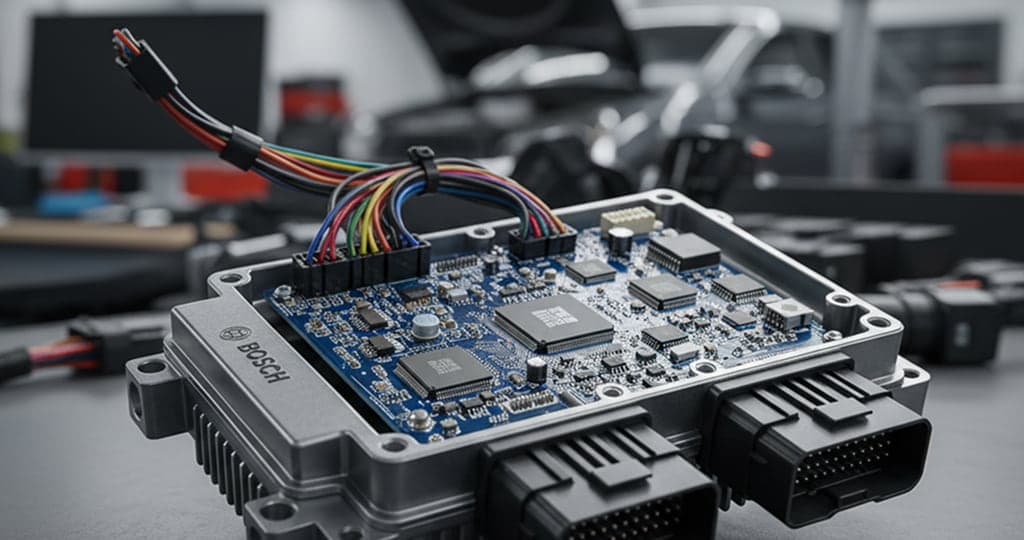
ECU tuning optimizes fuel, timing, and boost parameters for your specific modifications. Factory calibrations are conservative; proper tuning unlocks 20-30% more power from turbocharged engines through software alone.
Handheld programmers from Cobb or SCT offer pre-loaded tunes and data logging. Custom dyno tuning goes further, optimizing every parameter for maximum safe power. The difference in drivability and power delivery is substantial.
Cooling system upgrades
Performance driving generates heat that overwhelms stock cooling. Upgraded radiators with larger cores maintain safe temperatures during extended hard use. The difference between overheating and all-day reliability often comes down to radiator capacity.
Oil coolers are essential for track use. Thermostatic controls prevent overcooling during street driving. High-flow water pumps, electric fans, and lower-temperature thermostats further improve cooling efficiency.
Transmission and drivetrain parts
Performance clutches handle increased power through upgraded friction materials and clamping force. Organic compounds suit street use, while ceramic and metallic materials handle serious power at the expense of drivability.
Limited-slip differentials distribute power effectively between wheels, transforming launches and corner exits. Short-throw shifters and solid linkages improve shift precision and speed. These modifications enhance the mechanical connection between driver and drivetrain.
Performance wheels and tires
Tires are the most important performance modification. Everything happens through four small contact patches. Modern performance compounds offer incredible grip but require appropriate temperature conditions. Summer tires become dangerous below 40 degrees.
Lightweight wheels reduce unsprung weight, improving every aspect of performance. Forged wheels offer the best strength-to-weight ratio, flow-formed wheels provide good value. Proper sizing balances grip against rotational mass and acceleration.
Stop guessing what works. MotorMia's AI analyzes thousands of builds to show you proven upgrade paths for your exact vehicle.